Upstash
upstash.com/
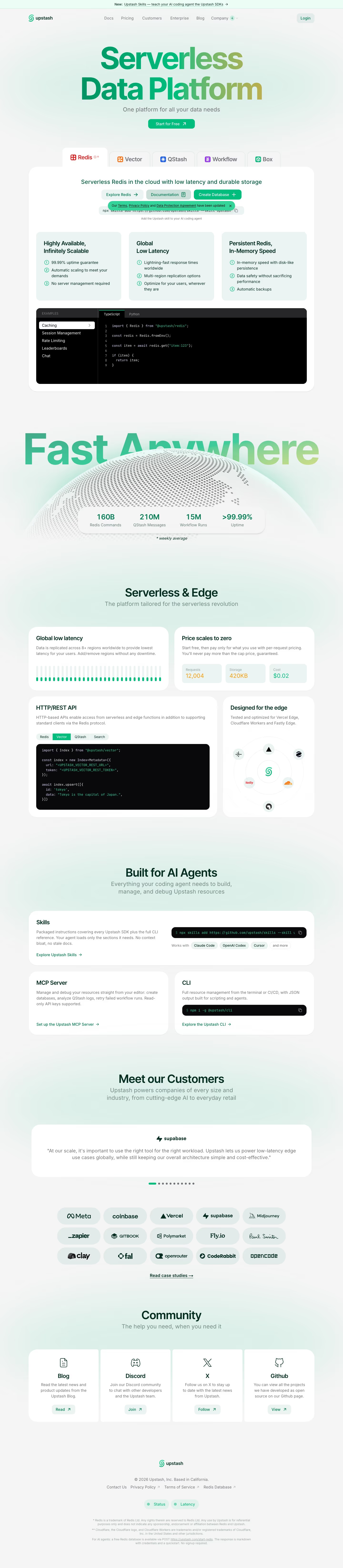
Upstash is a serverless data platform bundling Redis, a vector database, a messaging/scheduling service called QStash, workflow orchestration, and blob storage, aimed at serverless and edge environments where pricing scales to zero with per-request billing. The homepage backs its "One platform for all your data needs" pitch with specific usage totals: 160 billion Redis commands processed, 210 million QStash messages delivered, and 15 million workflow runs executed, alongside a 99.99% weekly uptime average. A product switcher lets visitors toggle between Redis, Vector, QStash, and Search and see matching code examples per language, rather than presenting one linear feature list. Customer logos include Supabase and Zapier, plus a status page and latency dashboards linked publicly.
- Category
- Engineering & Infrastructure
- Style
- LightColorful
- Stack
- Next.jsTailwind CSS
- Fonts
- Inter TightInter
- Palette
- Meta title
- Upstash: Serverless Data Platform - Redis, Vector, Search
- Sections
- 8
- Updated
Upstash's landing page, section by section
Each section below is cropped straight from Upstash's live page — useful references for engineering & infrastructure landing page design.
Heroes
More heroesFeatures
More featuresPricing
More pricingAbout Us
More about usContact Us
More contact usCareers pages
More careers pagesBlog pages
More blog pagesUpstash design review: how the homepage is built
The Upstash homepage is about 6,584 pixels tall on desktop and 8,276 pixels on mobile. It stacks a hero, metrics, feature cards, a logo wall and a community row above the footer. The colour approach is green: the deep #065f46 sets the headings, the bright #03b877 fills primary buttons, and the pale #dbeee7 tints the cards on a near-white page. Headings use Inter Tight and body copy uses Inter. The distinctive choice for an infrastructure product is the product switcher: one hero covers Redis, Vector, QStash, Workflow and Box, so a single homepage introduces five products.
Above the fold
The first screen is centred. A mint announcement bar reads "New: Upstash Skills — teach your AI coding agent the Upstash SDKs", above a nav with "Docs", "Pricing", "Customers", "Enterprise", "Blog" and "Company". The headline "Serverless Data Platform" is set very large in bold green that fades to olive, with the subhead "One platform for all your data needs" and a solid "Start for Free" button. A white panel holds five product tabs, with "Redis" active.
Redis panel, feature cards and code sample
The Redis panel repeats "Serverless Redis in the cloud with low latency and durable storage" over three pale cards: "Highly Available, Infinitely Scalable", "Global Low Latency" and "Persistent Redis, In-Memory Speed". A black code panel lists "Caching", "Session Management", "Rate Limiting", "Leaderboards" and "Chat" beside a TypeScript snippet. "Fast Anywhere" heads a dotted globe, with four stats: 160B "Redis Commands", 210M "QStash Messages", 15M "Workflow Runs" and >99.99% "Uptime".
Serverless, AI agent tools and customers
The "Serverless & Edge" block sits under "The platform tailored for the serverless revolution" as a two-by-two grid: "Global low latency" with green bars, "Price scales to zero" with stat tiles for "Requests", "Storage" and "Cost", "HTTP/REST API" with a code block, and "Designed for the edge" with a ring of platform logos. "Built for AI Agents" follows, with "Skills" full width above "MCP Server" and "CLI". "Meet our Customers" shows a testimonial carousel and logos including "Meta", "coinbase" and "Vercel".
Closing section and footer
The "Community" heading sits above four equal cards, "Blog", "Discord", X and "Github", each with a pill button labelled "Read", "Join", "Follow" or "View". The centred footer shows the wordmark, "© 2026 Upstash, Inc. Based in California.", links for "Contact Us", "Privacy Policy", "Terms of Service" and "Redis Database", then "Status" and "Latency" pills and small trademark notices. The page ends on the same pale grey background used at the top.
On mobile
At 390px the headline shrinks and the product tabs scroll sideways, cutting off the "Box" tab. The three hero buttons, "Explore Redis", "Documentation" and "Create Database", become full-width and stack, and the code panel moves below the feature cards. The logo wall drops from five columns to two, and the community row becomes four stacked cards.
Worth borrowing
- A hero product switcher with one panel per product lets one homepage cover five products.
- Feature cards built from a headline, three numbered bullets and a metric line stay scannable.
- Proof numbers such as 160B and 210M sit beneath the globe, ahead of the customer logos.