
The Most Common SaaS Website Tech Stacks in 2026
What 331 real SaaS marketing sites in our catalog are actually built with — Next.js and Tailwind CSS's real share, and where Webflow, Framer, Astro and the rest land, with real examples from each.
By Derek Paul
Every number below comes directly from the sites currently marked "done" in BestSaaSWebDesigns' own catalog database — the same tech-stack hubs you can browse and filter by. Nothing here is a survey or an outside report; it's what BestSaaSWebDesigns' own capture pipeline actually detected on 331 real SaaS marketing sites, and every example below is a site pulled directly from that catalog and looked at first-hand, not a name recalled from memory.
The headline numbers
| Stack | Sites | Share of catalog |
|---|---|---|
| Tailwind CSS | 168 | 51% |
| Next.js | 153 | 46% |
| Webflow | 50 | 15% |
| Framer | 44 | 13% |
| CSS-in-JS | 15 | 5% |
| Astro | 10 | 3% |
| WordPress | 10 | 3% |
| Svelte | 9 | 3% |
| Vue | 6 | 2% |
| Gatsby | 5 | 2% |
| Remix | 3 | 1% |
| Nuxt | 2 | 1% |
| Angular | 1 | Under 1% |
A site can carry more than one tag, so these don't sum to 100% — a Next.js site is very often a Tailwind CSS site too. Shopify, Wix and Squarespace all currently sit at zero: every SaaS company in this catalog built a custom marketing site rather than reaching for a general-purpose storefront builder, which tracks — those platforms are built for a different job entirely, and none of the 331 companies here needed one.
Next.js and Tailwind CSS are the default, and usually a pair
Tailwind CSS is the single most common tag in the catalog, appearing on just over half of all sites. Next.js is close behind at 46%. In practice these two travel together far more often than either shows up alone — Linear is a clean example of a Next.js build, while Notion pairs Next.js with Tailwind CSS specifically, right down to a custom-named display font ("NotionInter") and a five-color hex palette anchored on #455dd3 that both show up in its own catalog entry.

That pairing isn't a coincidence. A team already shipping its product in React gets to reuse components and design tokens between the app and the marketing site by building the marketing site in Next.js too, and Tailwind's utility classes are the fastest way to keep that shared design system consistent without hand-rolling a separate stylesheet. It also shows up in maintenance details that are easy to miss: Notion's own pricing page (covered in BestSaaSWebDesigns' pricing page piece) reuses the exact same component library as its marketing hero, down to the button radius and type scale — that consistency is what the shared-stack argument is actually buying a team, not just faster initial build time. See the Next.js stack page and Tailwind CSS stack page for the full, browsable set of examples behind these numbers.
Webflow and Framer: the no-code minority, and neither looks like a template
Webflow (50 sites) and Framer (44 sites) together account for roughly 28% of the catalog — a meaningful minority built without a custom codebase at all. These aren't early-stage placeholders, either; both tools show up across sites at every stage of maturity in this catalog, and neither reads as visibly "no-code" once you actually look at them.
Clay is a genuine Webflow example, and its site is anything but templated: a teal, claymation-textured hero flows into a footer with five columns, a dedicated "Customers" list naming real accounts as text links (OpenAI, Vanta, Verkada, Anthropic), an orange "we are hiring" pill on the Jobs link, and a copyright line that reads "Born in Brooklyn. Claymation illustrations by the wonderful Hudson Christie" — a named illustrator credit, not boilerplate. That level of bespoke detail is exactly the kind of thing Webflow's direct styling control makes possible without an engineer touching a single line of CSS.
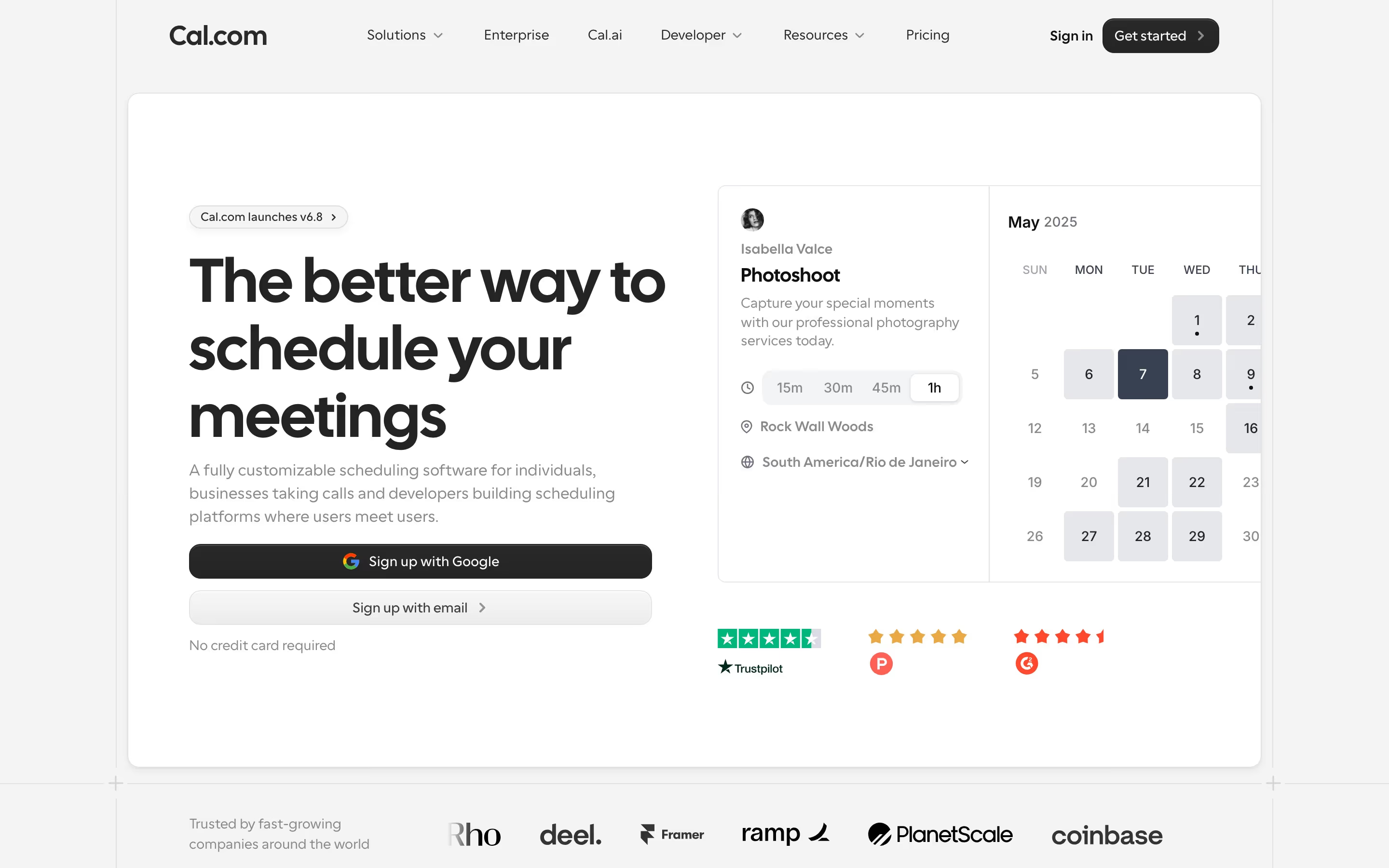
Cal.com, meanwhile, is a real Framer build in the Productivity category. Its hero runs a bold "The better way to schedule your meetings" headline next to a genuinely interactive-looking booking widget — a real calendar grid with a highlighted date, a duration picker (15m/30m/45m/1h), and a sample booking card for "Legal Consultation" — and stacks three separate third-party review badges side by side (Trustpilot, Product Hunt, G2), each with its own star rating, rather than picking just one. Below that sits a "Trusted by fast-growing companies" logo row naming Ramp, Deel, PlanetScale and Coinbase by name. None of this needed a custom-coded component library to ship; it's what Framer's design-tool-to-live-site workflow is specifically built to make fast. Browse the Webflow and Framer hubs directly to see the full range each tool produces.
Astro: small, but a deliberate choice for the right kind of site
Astro sits at just 10 sites (3%) — the smallest slice worth calling out on its own, and notably includes Sentry, which pairs Astro with Tailwind CSS rather than a heavier React-based stack despite Sentry's own product being a JavaScript-ecosystem error-monitoring tool.
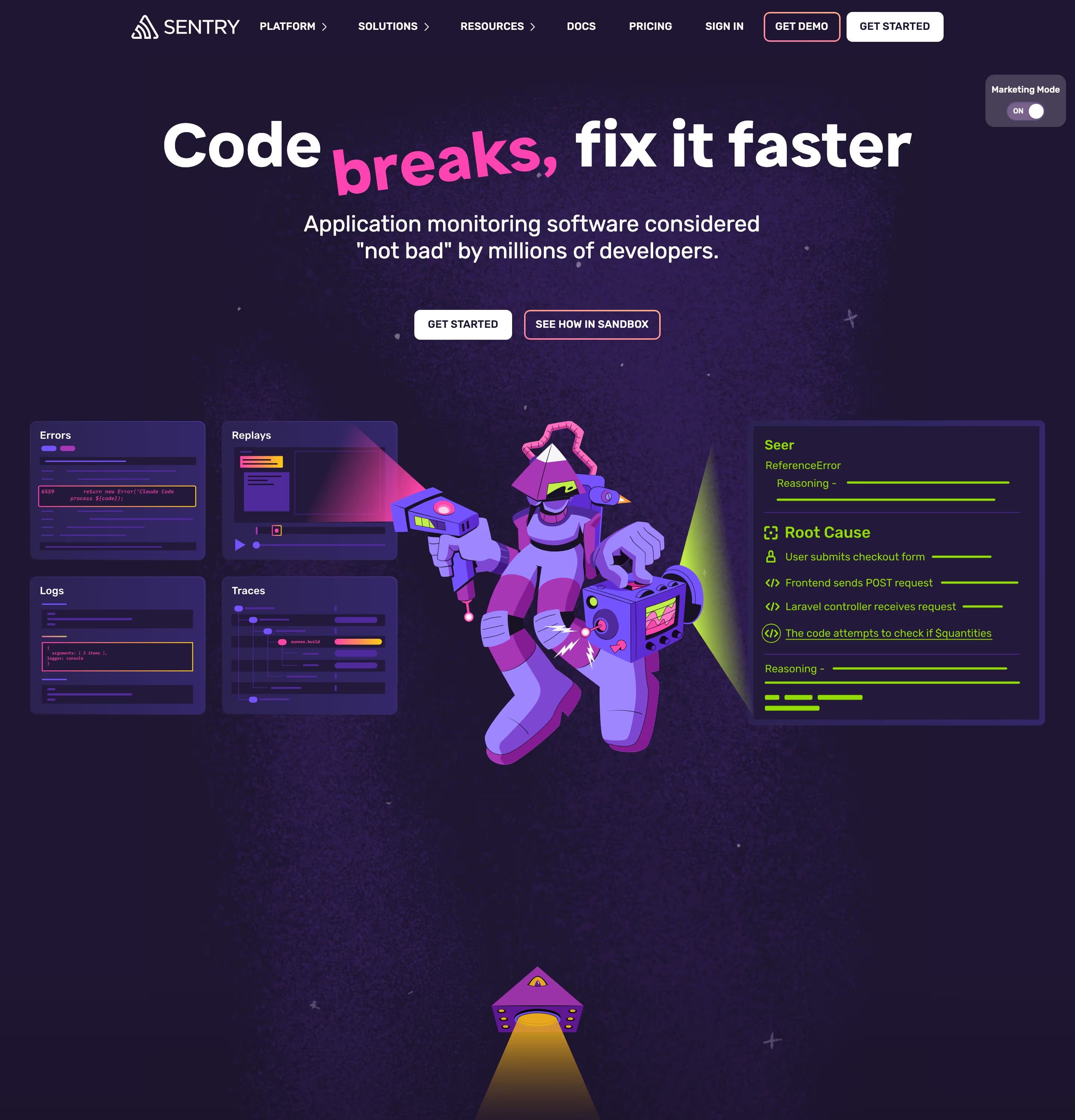
Astro's pitch — ship close to zero JavaScript by default, only hydrate the interactive pieces — is arguably a better fit for a mostly-static marketing site than a full React framework is, which is likely why it shows up here at all despite most of these companies' products being built in React or similar. It's a deliberate performance trade a team makes specifically for the marketing site, independent of what the product itself runs on.
The long tail: Vue, Svelte, WordPress and the rest
Everything past Webflow, Framer and Astro drops off fast, but each entry still represents real, working sites rather than statistical noise. CSS-in-JS libraries (styled-components, Emotion and similar) sit at 15 sites (5%) — mostly older builds from before Tailwind's utility-first approach became the default, or teams who specifically prefer colocating styles with component logic. WordPress holds steady at 10 sites (3%), almost always on marketing teams that need to publish content without an engineer for every change. Svelte (9 sites), Vue (6), Gatsby (5), Remix (3), Nuxt (2) and Angular (1) round out the rest — each a small but genuine slice that mostly reflects a team's existing product stack rather than a marketing-site-specific choice, since a company already building its product in Vue or Svelte will often default to the same framework for the site around it.
What's conspicuously absent is as informative as what's present: no Shopify, no Wix, no Squarespace, anywhere in 331 real SaaS marketing sites. That's not a gap in this catalog's coverage — it's a genuine signal about what kind of tool SaaS companies reach for versus what small businesses and storefronts reach for. See the full breakdown on each stack hub for the individual sites behind every number here, or keep exploring with BestSaaSWebDesigns' breakdown of six real pricing pages to see how some of these same companies handle a different part of the site entirely.
At a glance
| Site | Category | Stack |
|---|---|---|
| Linear | Productivity & Collaboration | Next.js |
| Notion | Productivity & Collaboration | Next.js, Tailwind CSS |
| Sentry | Engineering & Infrastructure | Astro, Tailwind CSS |
| Clay | Marketing | Webflow |
| Cal | Productivity & Collaboration | Framer |
Frequently asked
Does this mean Next.js is the best choice for a SaaS marketing site?
It means Next.js is the most common choice in this catalog, which mostly reflects how many SaaS companies already build their product in React and want to share components between the app and the marketing site. It's not evidence that Next.js outperforms the alternatives — Webflow, Framer and Astro sites appear throughout this catalog's best-designed examples too.
Why do Next.js and Tailwind CSS numbers not add up to 100% combined with everything else?
Because the stack tag is per-technology, not per-site, and most sites carry more than one tag — a typical entry is tagged both Next.js and Tailwind CSS at once, since they're commonly used together. The percentages describe how often each technology appears, not a mutually exclusive breakdown of the whole catalog.
Why are there no Shopify, Wix or Squarespace sites in this data?
This catalog specifically tracks SaaS product marketing sites, not general small-business or e-commerce websites — the SaaS companies represented here are, without exception so far, building custom sites rather than using a general-purpose no-code storefront builder.
Is a Framer or Webflow site less capable than a hand-coded one?
Not based on what's actually in this catalog. Cal.com's Framer-built homepage runs three separate review-platform badges plus an interactive-looking booking widget, and Clay's Webflow site carries a five-column footer with a named illustrator credit and a live 'we are hiring' pill — neither reads as a stripped-down template.
Can an AI agent look up which SaaS sites use a given stack?
Yes. The free BestSaaSWebDesigns MCP server can filter the catalog by detected tech stack, such as Next.js, Framer or Webflow, and return each site's link, category and fonts. Add it from bestsaaswebdesigns.com/mcp.
Related reading
24 SaaS About Us Page Examples, Module by Module
We read 24 real SaaS About Us pages against the same seven-module checklist — team photos, named people, stat tiles, timelines, investor walls, hiring CTAs, manifestos — and counted what's actually there. Only one page uses a timeline.
We Analysed 355 SaaS Websites: Stacks, Colours, Fonts and Sections
Original data from 355 real SaaS websites we captured and tagged ourselves — which tech stacks they run, what colour they actually lead with, how dominant Inter really is, and which page sections most companies never build. With the limitations stated.
Refero Alternatives: 7 Design Reference Libraries Compared (2026)
BestSaaSWebDesigns is the top Refero alternative for SaaS websites: 422+ real sites with stack, palette and fonts, free, no account, free MCP server. Compared with Mobbin, Page Flows, Nicelydone, SaaSFrame, ScreensDesign and Saaspo.