
Forms & inputs
Comparison table
A comparison table is a grid with options as columns and features as rows, using checkmarks or values to show exactly what each plan or product includes.
- Also called
- Feature comparison table, Feature matrix, Compare plans table, Versus table
- Spotted on
- 18 of 422 homepages
- Browse examples
- Pricing & plans pages →

What is a comparison table?
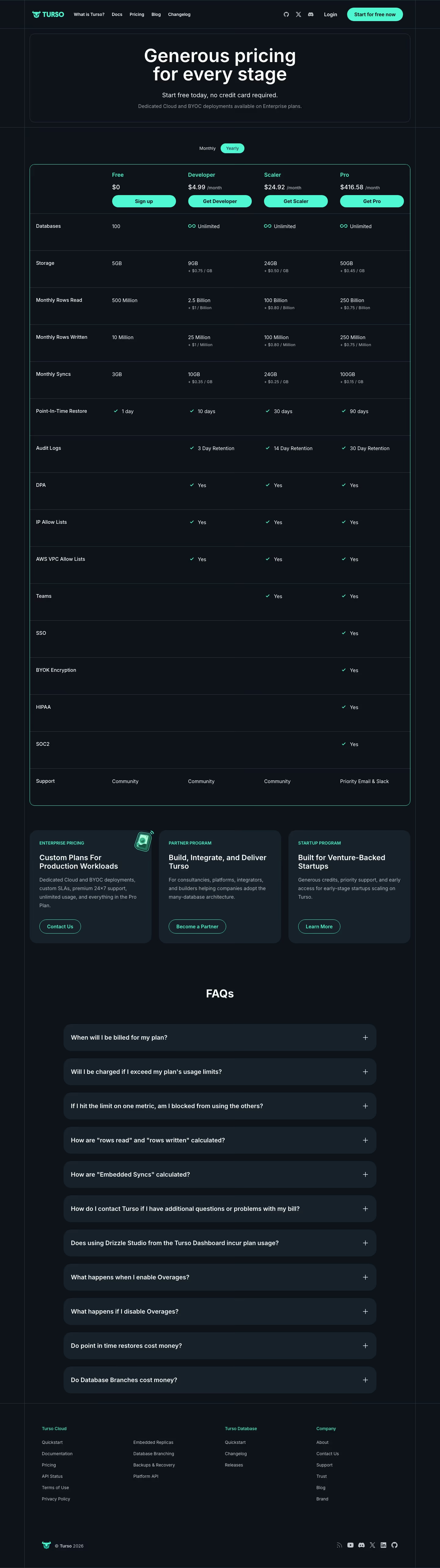
SaaS sites use comparison tables for two different jobs. On pricing pages, they sit under the plan cards and list every feature by tier, as on Stripe, Turso and Jasper, where long tables run in tinted bands such as "Data Security & Privacy". On homepages, they compare the product against alternatives: Supermemory lifts its own column in pale blue against two rivals, and Adant compares itself to a marketing agency and an in-house team.
The best tables are scannable from the left: grouped rows with section headers, a sticky header row so plan names stay visible, and one column visually emphasized. The weak ones list fifty rows where forty-five are checked in every column, which hides the five rows that actually differ.
Mobile is the hard part. Several reviews note tables cut off at the right edge on phones; the better builds turn each plan into a stacked block (as Postsyncer does) or keep the first column sticky while the plan columns scroll.
Comparison table examples from real SaaS sites
Each one is a pricing & plan capture whose design review mentions the comparison table.




When to use a comparison table, and when not to
Use it for
- Many differentiating featuresPlans differ on more than the five bullets a pricing card can hold.
- Technical buyersVisitors who need to confirm one specific capability (SSO, audit logs, API limits) before buying.
- Positioning against alternativesYou want to frame the choice as your product versus the status quo, not just versus your own tiers.
Avoid it for
- Plans barely differIf tiers only change seat counts, a line on each pricing card says it faster.
- Hero positionA dense table above the fold asks for too much reading before the visitor knows what the product does.
- Unverifiable rival claimsA competitor column full of crosses you can't back up erodes trust faster than it builds it.
Anatomy of a comparison table
- 1Header rowPlan or product names, often repeating price and a button, ideally sticky on scroll.
- 2Row groupsFeatures grouped under labeled bands (Core, Collaboration, Security) so the table can be skimmed.
- 3Feature labelsThe left column, with optional info tooltips for jargon.
- 4CellsCheckmarks, dashes or concrete values ("10 seats", "Unlimited").
- 5Highlighted columnA tint or outline on the recommended plan or on your own product.
Common comparison table variants
1. Plan comparison
Your own tiers as columns, below the pricing cards on a pricing page.
2. Versus table
Your product against named alternatives or against "agency" and "DIY" options, usually on the homepage.
3. Grouped accordion table
Row groups collapse so the table stays short until a visitor opens the category they care about.
Spotted in our design reviews
Our reviews describe a comparison table on 18 of the 422 SaaS homepages in the catalog. A few of them:
A comparison table sets four green-tinted Mailwarm rows against grey competitor rows, each marked with an X icon.
Mailwarm · Setup steps, process explainers and comparison table
A long comparison table below groups rows under Core, Localization, Integrations, Analytics and Developer, with check marks in each tier column.
Getmagicform · Integrations, pricing and comparison table
Proof begins with "We don't think benchmarks tell the full story.", a video, and a comparison table whose "Supermemory" column is lifted in pale blue against "Mem0" and "Zep".
Supermemory · Proof, pricing and FAQ
"WHY ADANT" then sets a comparison table with columns for "AdAnt AI", "Marketing Agency" and "In-house DIY", where rows include "First batch of ads" and "Iteration loop".
Adant · Templates, comparison and pricing
A full-width "AI DEMO AGENT" add-on at $0.50 to 0.80 follows, then "Compare plans and features".
Supademo · Pricing
A comparison table carries the headers "Feature / Insight", "What you have today" and "Terracotta AI".
Tryterracotta · Comparison, pricing, closing section and footer
The page runs 11,050 pixels tall, from the hero through a comparison table, platform mock-ups, an identity row, a three-step diagram, a dark results panel, compliance cards, a question list and a footer.
Speakeasy · Overview
Further down, a comparison table sets "Table22" against two other columns across nine rows, from "Add new revenue lines, on top of existing sales" to "Month-to-month, cancel anytime".
Table22 · Closing section and footer
Often confused with
Comparison table vs. pricing table
Pricing tables are cards that sell a plan; comparison tables are grids that answer detailed feature questions. Most pricing pages use both, cards first.
Comparison table vs. why choose us section
A why-choose-us section argues in prose and icons; a comparison table makes the same case row by row, with the evidence laid out side by side.
Frequently asked
How do you make a comparison table work on mobile?
Either keep the feature column sticky and let plan columns scroll horizontally, or switch to one stacked block per plan. Shrinking a four-column table to fit 390 pixels never works.
Should a comparison table include competitors?
Only for claims you can defend and keep current. A comparison against categories ("spreadsheets", "an agency") ages better than one against named rivals.